iBobby AI Speaker
iBobby is an AI-powered life assistant developed by Chung-Hwa Telecom. The name "Bobby" sounds like "baby" in Chinese. The speaker aims to improve bonding between family members and keep children company.
Daily check-in campaign
Project scope
To keep users engaged, we created a daily check-in campaign. Users can check in every day between 10:00 AM and 10:00 PM to earn Hami points, which can be used on any Chung-Hwa Telecom platform. The marketing team provided different tasks for users to complete in order to collect points. We thus promoted different product functions while collecting more user data.
Project details
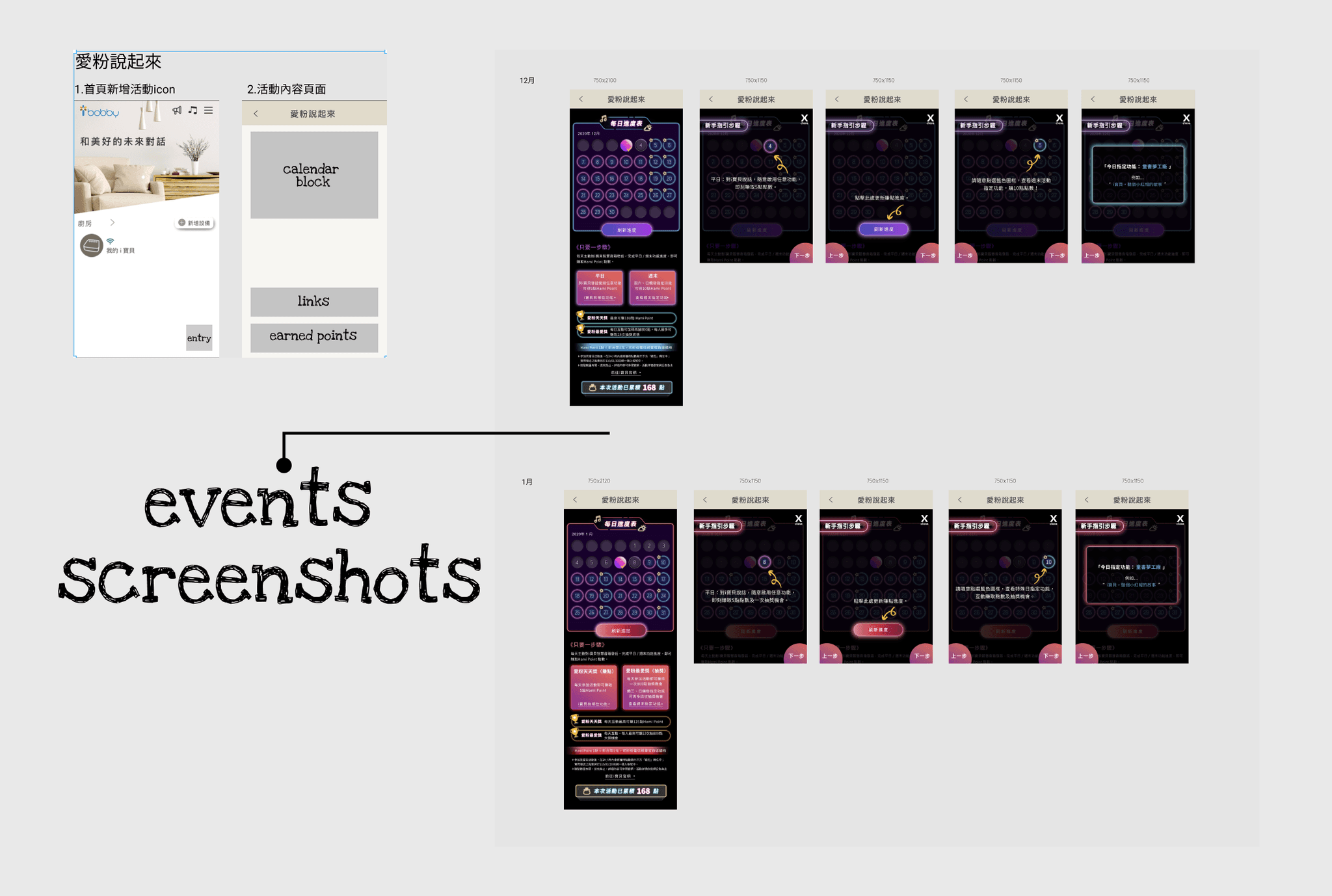
The campaign had an entry point in the iBobby app. To attract users, we discussed several layouts and conducted internal interviews, which convinced us to place the entry point icon in the bottom-left corner of the screen.
I collaborated with the UX designer and marketing specialist to design the first wireframe. The UI included a calendar to indicate the user's progress and guide them in everyday tasks.
My key contribution was creating the design flow for earning points. Since we had to use APIs from the Hami wallet team to generate the actual points earned by the user, the points shown on the event page were updated daily, between 10 PM and 10 AM of the next day.
We also fine-tuned the UI every month to make it more interesting:
The outcome
- Improve monthly active users by 20% in 6 months.
Taiwanese support
iBobby is equipped with AI technologies that were developed in-house, including Speech-to-Text (STT), Natural Language Processing (NLP), and Text-to-Speech (TTS). As Taiwan is the primary market for the product, we focused on Taiwanese language support.
The Problems
The challenge we faced was to enable Speech-to-Text (STT), Intent Classification, and Text-to-Speech (TTS) capabilities specifically for Taiwanese speakers. We needed to integrate these features into our IoT ecosystem to allow users to interact with consumer IPTV services and smart appliances in Taiwan.
Project details
- The first iteration recognized Taiwanese, but responded in Mandarin.
- We developed a larger Taiwanese corpus and fine-tuned the models.
- Finally, iBobby was able to recognize and reply in Taiwanese :D